
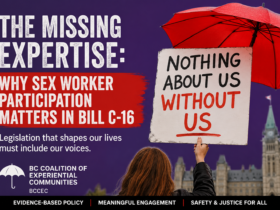
The Missing Expertise: Why Sex Worker Participation
Matters in Bill C-16
BCCEC submission to the Senate Justice Committee
Submitted by:
Susan Davis
Executive Director
BC Coalition of Experiential Communities (BCCEC)
604-671-2345
Land Acknowledgement
The BC Coalition of Experiential Communities acknowledges that our work takes place on the traditional, ancestral, and unceded territories of Indigenous Peoples across what is now known as British Columbia. We recognize the ongoing impacts of colonialism and affirm the importance of Indigenous self-determination, safety, and inclusion in public policy development.
Executive Summary
The BC Coalition of Experiential Communities (BCCEC) respectfully submits that the Senate’s study of Bill C-16 is incomplete without the meaningful participation of sex workers and sex worker-led organizations.
Although sex workers are not mentioned once in Bill C-16, the legislation repeatedly addresses concepts including exploitation, trafficking, coercive control, victimization, vulnerability, and gender based violence. These concepts have historically been used to justify laws, policies, and practices that have had significant impacts on sex workers and their families.
The concern is not that these forms of violence should not be addressed. They should. The concern is that Parliament appears to have developed legislation touching on concepts that directly affect sex workers without meaningfully considering sex workers as a population that may be affected by implementation.
This omission raises important questions regarding evidence-based decision making, Gender-Based Analysis Plus (GBA+), meaningful engagement, and Parliament’s commitment to ensuring that sex workers are entitled to the full protection and equal benefit of the law.
As discussed throughout this submission, several provisions of Bill C-16 raise questions regarding the interpretation of coercive control, trafficking-related concepts, criminal harassment, and victim centred frameworks. These examples illustrate how the exclusion of sex workers from legislative development can leave important questions unanswered regarding foreseeable impacts on sex workers, their families, intimate partners, and support persons.
The Senate has an obligation to address this omission before Bill C-16 proceeds. The Senate must ensure that legislation is informed by evidence from affected populations. Given the absence of sex workers from Bill C-16 and the legislative record surrounding it, the Senate should hear directly from sex workers and sex worker-led organizations before completing its study of the bill.