
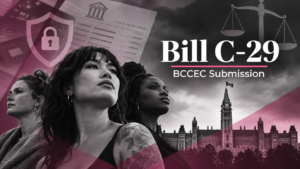
BC Coalition of Experiential Communities (BCCEC)
Submission to the Standing Committee on Justice and Human Rights
Bill C-29 — An Act to Establish the Financial Crimes Agency
45th Parliament, 1st Session
November 2026
Subject: The Foreseeable Expansion of Discriminatory Financial
Enforcement Against Women Who Do Sex Work
Who We Are
Since 2002, the BC Coalition of Experiential Communities (BCCEC) are a democratic organization of sex workers representing diverse race, gender and genre in sex work across the BC Region. Our work focuses on law and policy reform being based on evidence and fact and on placing the voices of sex workers at the center of all work that could impact our lives and safety.
2. Principal Objections to Bill C-29
BCCEC strongly opposes advancing Bill C-29 without a comprehensive examination of its foreseeable consequences for women who do sex work.
We are deeply concerned that this legislation is laying the groundwork for a significant escalation in the criminalization, financial exclusion and discriminatory policing of a large, readily identifiable group of women in Canada.
This is not simply a proposal to improve Canada’s response to sophisticated financial crime. It would establish another federal law enforcement agency with investigative and asset-recovery responsibilities, operating within a financial intelligence system whose discriminatory consequences remain inadequately examined and addressed.
Women who do sex work have already experienced the consequences of FINTRAC’s financial intelligence indicators, guidance and educational products, including discriminatory risk classifications, banking exclusion and denial of payment processing. We have challenged these practices through Canada’s human rights system because of the absence of adequate gender-based analysis, human
rights risk assessment, meaningful consultation and accountability.
We have also heard accounts from women whose money has been seized under existing proceeds-ofcrime authorities, requiring months or years of effort to recover their earnings. In one particularly disturbing account, a woman was informed that her seized funds were irretrievable.
These concerns must also be understood against the documented history of police discrimination, abuses of authority and failures of protection involving women who do sex work.
How can the Government of Canada reasonably expect our community to trust that another federal law enforcement agency will exercise its powers fairly when existing institutions have repeatedly failed to protect our rights?
Bill C-29 threatens to deepen these existing harms by introducing additional investigative and asset recovery capacity into a system that has already demonstrated serious deficiencies in protecting ourrights.
Of particular concern is the legislation’s inclusion of possession of proceeds of crime within thedefinition of financial crime.
Under PCEPA, purchasing sexual services is criminalized, while women selling our own sexual services are protected from criminal liability. Yet the government has not adequately explained how this distinction protects our earnings from being characterized as criminal proceeds arising from the purchaser’s offence.
The possibility that women could be investigated, deprived of their bank accounts or have their money and property seized because of offences committed by purchasers demands immediate parliamentary scrutiny.
Our concerns are further compounded by existing asset-forfeiture arrangements under which revenue from forfeited property can support law enforcement and other government activities.
The possibility that women’s lawful earnings or property could be improperly seized, forfeited and ultimately used to finance further enforcement against our community represents a particularly disturbing potential abuse of state authority.
Why should women who do sex work trust that these powers will not be misused when we have already experienced discriminatory financial intelligence practices and heard accounts of unjustified seizures under existing enforcement authorities?
Why is the government proposing to expand this system before examining the harms it has already caused?
And why does Bill C-29 fail to expressly require the preventive human rights safeguards, independent oversight and gender-based analysis necessary to ensure that existing discriminatory practices are not reproduced or intensified?
This legislation represents a serious and foreseeable risk to the income, property, housing security, privacy, equality and personal safety of women who do sex work.
Parliament must examine that risk before granting additional financial crime enforcement powers.
To see the full submissions in English and French please click the links above.