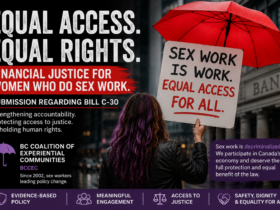
Submission Regarding Bill C-30
An Act to Implement Certain Provisions of the
Spring Economic Update Tabled in Parliament on April 28, 2026
BCCEC-Submission-Bill-C-30.pdf
Submitted by:
Susan Davis
Executive Director
BC Coalition of Experiential Communities (BCCEC)
604-671-2345
Land Acknowledgement
The BC Coalition of Experiential Communities acknowledges that our work takes place on the traditional, ancestral, and unceded territories of Indigenous Peoples across what is now known as British Columbia. We recognize the ongoing impacts of colonialism and affirm the importance of Indigenous self-determination, safety, and inclusion in public policy development.
Who We Are
Since 2002, the BC Coalition of Experiential Communities (BCCEC) are a democratic organization of sex workers representing diverse race, gender and genre in sex work across the BC Region.
Our work focuses on law and policy reform based on evidence and fact and on placing the voices of sex workers at the centre of all work that could impact our lives and safety.
The BCCEC works on issues relating to public safety, housing, health care, access to justice, financial services, human rights, and government policy. Our work is informed by lived experience, community engagement, and research.
Why This Matters to Sex Workers
Sex work is decriminalized in Canada. While aspects of Canada’s legislative framework continue to regulate the purchase of sexual services and related activities, the act of selling sexual services is lawful. As a result, sex workers participate in Canada’s financial system as workers, self-employed individuals, business owners, tenants, borrowers, taxpayers, and consumers.
Like other Canadians, sex workers open bank accounts, obtain mortgages, use payment systems, receive income, pay taxes, operate businesses, and participate in economic life. Legislation affecting financial systems, accountability mechanisms, and access to remedies is therefore directly relevant to our community.
The Population Project is the most comprehensive empirical count of sex workers ever conducted in Canada. The project identified a minimum of 169,000 Canadians who have engaged in sex work and approximately 26,000 people participating in any given month. The findings demonstrated that sex workers represent a substantial population of Canadians rather than a small or isolated group. The project further found that approximately 83% of participants were women.
These findings are significant from a GBA+ perspective. Women who do sex work are not a trivial population and cannot be dismissed as too small to warrant consideration when legislation, policy, regulatory frameworks, or institutional practices may affect their lives. Where foreseeable impacts exist, meaningful consideration of those impacts is required regardless of whether a community is explicitly named within the legislation.
Sex workers experience significant barriers to financial participation due to the continued conflation of sex work and human trafficking.
Although sex work is lawful, women who do sex work continue to report barriers in accessing banking services, mortgages, payment processing services, credit, investment products, and other financial tools necessary for full participation in economic life.
These barriers are not hypothetical. They have been documented through community engagement, organizational advocacy, human rights complaints, and the lived experiences of women who do sex work across Canada. Experiences reported to our organization include account closures, denial of financial services, inability to access mortgages or business financing, enhanced scrutiny of transactions, restrictions on payment processing, account closures, and exclusion from financial products available to other Canadians.
The concern is that lawful sex work is frequently conflated with human trafficking, money laundering, organized crime, or other forms of criminal activity. This conflation can result in women who do sex work being treated as inherently suspicious despite engaging in lawful economic activity.
The concern raised in this submission is not that Bill C-30 is directed at sex workers. Rather, it is that accountability mechanisms within financial systems should be examined through a human rights and GBA+ lens to ensure that communities already experiencing disproportionate scrutiny or exclusion are not adversely affected by legislative changes that reduce access to remedies.
The purpose of GBA+ is to identify and address foreseeable impacts before they occur, particularly where legislation may affect groups that are not explicitly named in the legislation itself.